Nepal: Potato Output Triples to 3.52 Million Tonnes Since 2000, but Yields Stay at 16.7 t/ha
Βασικά καραβάνια
- 3.52 Mt of potatoes harvested in Nepal in 2023/24 season
- 16.65 t/ha national yield, below 24.6 t/ha in India (2024)
- 211,505 ha under potatoes, up from 197,037 ha in 2014/15
- 29% of the national crop comes from Koshi Province alone
Γιατί έχει σημασία
- Για τους αγρότες
- Compare your yield with the Bagmati average of 18.73 t/ha; if you are near the Madhesh level of 14.35 t/ha, review seed quality first.
- Για προμηθευτές
- Focus seed and fertiliser programmes on Madhesh and Karnali, where yields of 14–15 t/ha trail the best provinces by 3–4 t/ha.
- Για τους επενδυτές
- Look at storage and seed projects in Koshi, which grows 29% of the crop, including the largest district, Jhapa.
Σύνοψη 60 δευτερολέπτων
Nepal has become a sizeable potato producer, but its productivity has hit a ceiling. Ministry data put the 2023/24 crop at about 3.5 million tonnes, roughly triple the volume of 2000, harvested from some 211,500 hectares. Across the last decade, volume rose by more than a third while land grew by only 7%, a sign that better yields did most of the work. Since the 17.2 t/ha peak of 2021/22, however, averages have edged down to 16.65 t/ha, and the latest increase came mainly from 7,700 extra hectares. Koshi supplies nearly three tonnes in every ten, while Madhesh lags at 14.35 t/ha against almost 19 t/ha in Bagmati. For seed, fertiliser and storage suppliers, the provincial gap is a clear target, and for regional buyers it signals where extra volume could appear. The caveat is that the FAO series for 2024 simply repeats the national figure, so there is no fully independent check.
Nepal harvested 3,521,794 tonnes of potatoes in 2023/24, according to the Ministry of Agriculture and Livestock Development (MoALD). The crop covered 211,505 hectares. The average yield was 16.65 t/ha. FAOSTAT, published by Our World in Data, shows the same volume for 2024.
In 2000, Nepal produced 1.18 million tonnes, according to FAOSTAT. The yield was then 9.6 t/ha. Output has therefore roughly tripled in 24 years.
Ten years of steady gains
The ministry series starts in 2014/15. That season, farmers harvested 2,586,287 tonnes from 197,037 hectares. The yield was 13.13 t/ha. Since then, output has grown by about 36%. The area grew by only about 7%.
Καθημερινές. Διαγραφείτε με ένα κλικ.
The yield peaked at 17.20 t/ha in 2021/22. It slipped to 17.11 t/ha in 2022/23 and 16.65 t/ha in 2023/24. In the last season, the area jumped by about 7,700 hectares. Output rose by just 1%.
Where the potatoes grow
Koshi Province is the largest producer. It harvested 1,022,952 tonnes from 62,174 hectares in 2023/24. That is about 29% of the national crop. Bagmati followed with 750,618 tonnes. Madhesh produced 496,372 tonnes.
Yields differ widely between provinces. Bagmati reached 18.73 t/ha and Sudurpashchim 18.44 t/ha. Madhesh, in the southern plains, averaged only 14.35 t/ha. Karnali averaged 15.23 t/ha.
Jhapa in Koshi is the largest potato district. It planted 15,795 hectares and harvested 258,564 tonnes. Kavre in Bagmati harvested 209,070 tonnes from 10,100 hectares.
The gap with neighbours
Nepal still trails its large neighbours. FAOSTAT shows an average yield of 24.6 t/ha in India and 20.8 t/ha in China in 2024. Nepalese growers would need about 50% more per hectare to match India.
Γιατί έχει σημασία
Growth over the past decade came mostly from yield, not land. Yet yields have stalled for three seasons. The 2023/24 gain came almost entirely from extra area.
The spread between provinces shows where the gains could come from. If Madhesh reached the Bagmati yield, it would produce about 150,000 tonnes more on the same land.
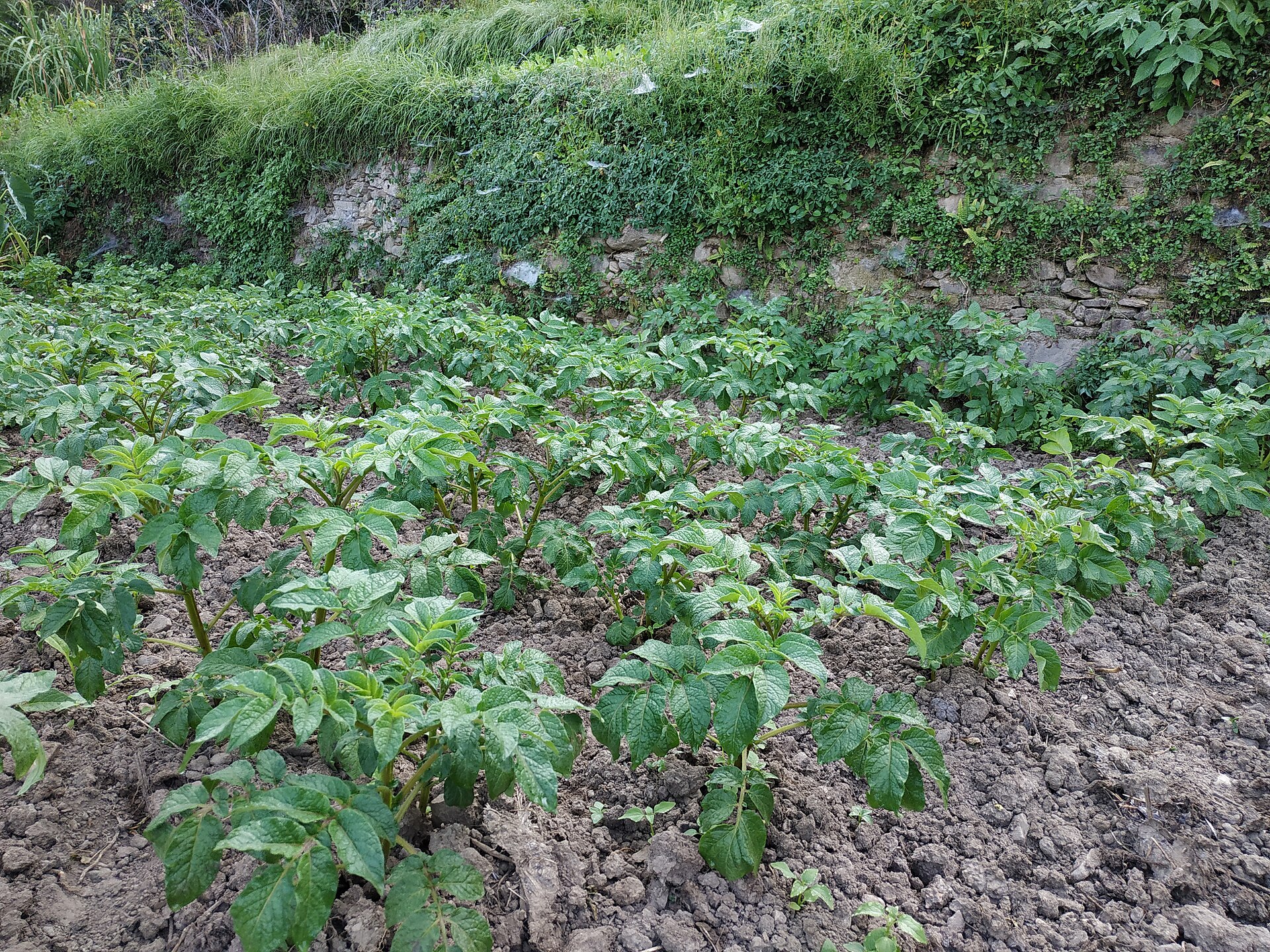
Photo: A potato field in the hills of Nepal (illustrative). Nirajan_pant / Wikimedia Commons, CC BY-SA 3.0
Παγκόσμια Σύνοψη Πατάτας
Οι πέντε κορυφαίες ιστορίες, τιμές, ειδοποιήσεις για ασθένειες και εκδηλώσεις. Καθημερινά πρωινά, χωρίς διαφημίσεις.
Τι επόμενη
The ministry has not yet published 2024/25 data. The key question is whether yields recover above 17 t/ha or growth keeps relying on extra area.
Πηγές
- MoALD, Statistical Information on Nepalese Agriculture 2080/81 (2023/24), Tables 2.1–2.3 — https://giwmscdnone.gov.np/media/pdf_upload/StatisticalInformationonNepaleseAgriculture,2080_81_a7s8aj4.pdf
- FAOSTAT μέσω του Our World in Data, Παραγωγή πατάτας — https://ourworldindata.org/grapher/potato-production
- FAOSTAT μέσω του Our World in Data, Αποδόσεις πατάτας — https://ourworldindata.org/grapher/potato-yields
Σύνδεσμος σε αυτό το υλικό
- Χώρα
- Νεπάλ
Σχετικές ιστορίες
Περού: Η παραγωγή πατάτας διπλασιάστηκε σε 6.58 εκατομμύρια τόνους από το 2000, καθώς οι αποδόσεις φτάνουν τους 19.5 τόνους/εκτάριο
Βολιβία: Η συγκομιδή πατάτας φτάνει τους 1.38 εκατομμύρια τόνους, αλλά οι αποδόσεις παραμένουν κοντά στους 6.5 τόνους/εκτάριο